 Salkantay Trekking Tours
Salkantay Trek Packing List
This Salkantay trek packing list covers what to pack for a route that crosses freezing high Andes and ends in humid cloud forest. Soraypampa nights sit near 2 C, the pass day hovers around 6 to 15 C, and Machu Picchu can reach 24 C, so you need warm layers and rain gear in the same duffel. Horses or porters usually carry 5 to 7 kg of your gear between camps, and you hike with a daypack. Below you will find the conditions table, a full list with reasons, what the bookable tours provide, and what you should rent rather than carry. The bookable treks are compared on Salkantay trek tour.
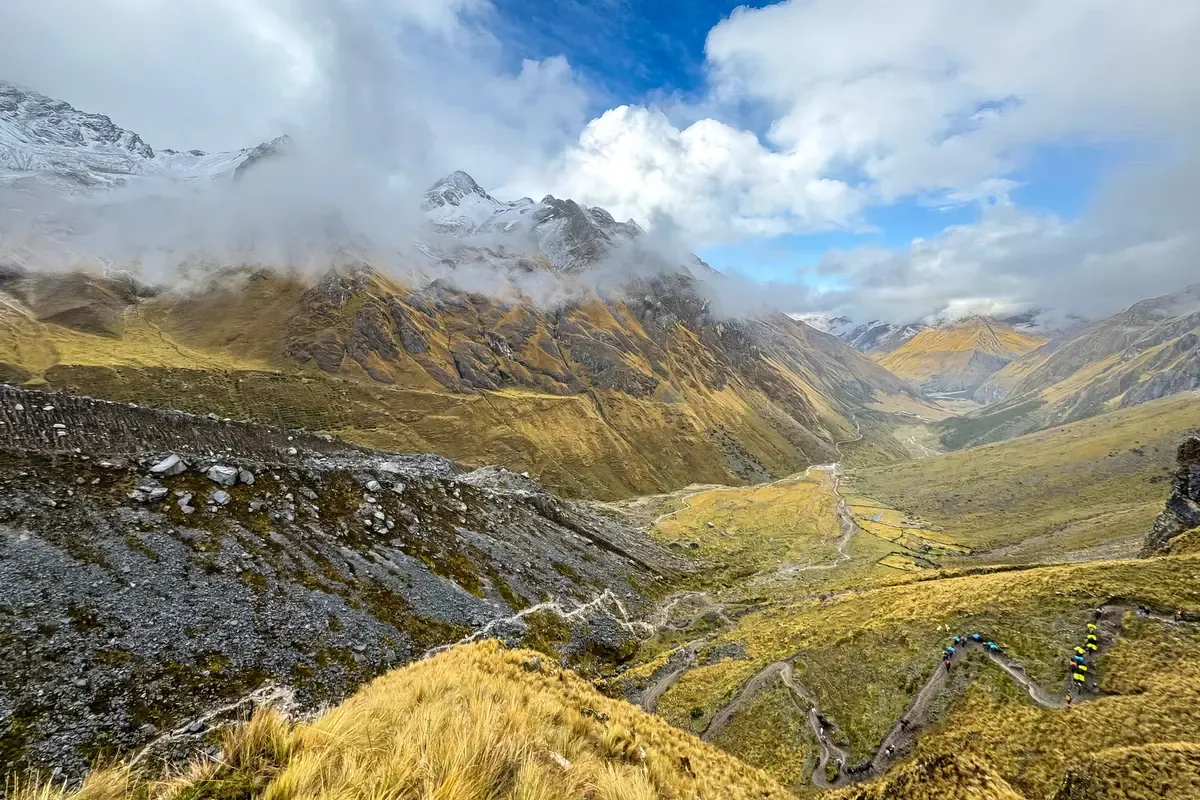
The switchbacks below the Salkantay Pass with the glacier peaks in cloud. Photo: Steve FUNG, CC BY-SA 4.0, via Wikimedia Commons
Quick answer The short answer
Operators estimate about 2 C at Soraypampa and up to 24 C near Machu Picchu, and keep your mule duffel to 5-7 kg. Bring a sleeping bag rated to -10 C, a waterproof jacket and poncho, and cash in soles for the trail fee of roughly S/10 to S/20. The passport must travel with you for the trailhead checkpoint and Machu Picchu entry.
Key takeaways
- The full Salkantay trek packing list is grouped by clothing, sleep, feet, day pack, documents and health.
- Some tours already include the sleeping bag and poles, see what the tours provide with prices.
- Comparing the bookable treks side by side lives on the Salkantay trek tours homepage.
- Temperatures by season belong on the best time to do the Salkantay trek page.
What the Weather Asks For
The trek climbs from about 3,900 m at Soraypampa to the Salkantay Pass near 4,600 m, then drops into cloud forest and finishes at Aguas Calientes at 2,040 m. Operators quote different figures for the pass, from 4,580 m to 4,660 m, and the conditions change faster than the altitude does.
Three Climates on One Route
The table below gathers operator temperature estimates for each stretch of the route, taken from published trek weather pages. Use it to decide how much warm clothing and how much rain gear to carry. The high camps need a cold-rated bag, the lower jungle sections need light long layers against insects, and every day needs some protection from rain.
For month-by-month rainfall and season detail, the seasons page covers it in depth.
| Section | Altitude | Conditions |
|---|---|---|
| Soraypampa and Salkantay Pass | About 3,900 m at camp, pass quoted 4,600 to 4,630 m | Operator estimates of 14 C to 2 C at Soraypampa and 15 C to 6 C around the pass day. Rain can turn to snow and slush on the pass. Nights in the dry season reach about 0 C, and minus 5 C in winter. |
| Cloud forest (Lucmabamba, La Playa) | Lucmabamba section estimated 22 C to 15 C | Warm, humid and rainy. Sand flies bite, so long sleeves and long trousers matter more than warmth. Aguas Calientes receives about 2,116 mm of rain a year, almost three times Cusco. |
| Aguas Calientes and Machu Picchu | 2,040 m and 2,430 m | Estimates of 24 C to 18 C near Aguas Calientes and 24 C to 16 C at Machu Picchu. Hot afternoons, wet air, and a final climb that starts in the dark for sunrise. |
Why the List Looks Contradictory
One independent guide sums it up plainly: the route passes from alpine terrain with freezing nights to humid cloud forest with much warmer conditions, so both hot and cold clothing are needed. A traveller who crossed in wet weather reported rain turning to snow and slush on the pass, with waterproof layers keeping him dry through 7 hours of it. That is the packing problem in one sentence.
You dress in removable layers in the morning, strip down as you descend, and keep the shell jacket on top of the duffel, not buried at the bottom.
The Packing List
Every item below earns its place with a reason. On a guided trek your duffel rides a mule or a porter, and independent hikers are advised to keep total packs at 4 to 7 kg, so nothing here is decorative.
Clothing
Dress in layers you can remove while walking. Operator estimates run from about 2 C at Soraypampa to 22 C at Lucmabamba, so a heavy single jacket is worse than three thin pieces. Keep one dry set of camp clothes in a plastic bag inside the duffel.
- Base layer tops, because Salkantay Trekking notes temperatures can drop below 0 C (32 F) in the high areas and recommends a base layer.
- Fleece or insulated mid layer for the mornings at 3,900 m, where operators estimate lows near 2 C.
- Waterproof jacket, recommended by Salkantay Trekking together with a small poncho as a two-part rain system.
- Rain covers for your pack and electronics, on the same operator list.
- Long sleeves and long trousers for days 3 and 4, because sand flies bite in the jungle sections and exposed skin loses.
- Shorts or convertible trousers for the warm afternoons below 2,500 m, where estimates reach 24 C.
- Warm hat and gloves for the pass morning and the dark start before Machu Picchu, which begins before sunrise.
- Sun hat, because the sun is far more intense at altitude.
Sleep
Check whether your tour supplies the bag before you buy or pack one. Some listings include it, others rent it, and one 5-day listing excludes it entirely, which the section below spells out with prices.
- Sleeping bag rated to -10 C. Operators advise synthetic, mummy-shaped bags with a hood, and Alpaca Expeditions recommends down for the same rating. This is the safe choice for the high camps, where dry-season nights sit near 0 C.
- Sleeping bag liner, useful with a rental bag.
- Inflatable or foam mat if your tour does not include one. Alpaca Expeditions counts a bag and mat together at 3.5 kg of a porter load.
Feet
Day 2 is the hardest day of the trek, with the steep ascent to the pass followed by a long drop toward Chaullay. Poles and firm boots do more for that day than any other item in the duffel.
- Broken-in waterproof hiking boots with ankle support for the climb and the steep descent on pass day, which is described as knee-punishing.
- Trekking poles of about 350 g per pair, adjustable. Salkantay Trekking recommends them and one traveller bought a walking stick for 5 soles to save her knees on the day 2 descent.
- Sandals or camp shoes for the evenings.
- Three or four pairs of hiking socks, with a dry pair reserved for sleeping.
Day Pack
One trekking guide puts a typical daypack at about 5 kg, about 8 kg with camera gear. Guided companies supply boiled water for refilling at meals and in the mornings, so you only carry the water for the first hours of each day.
- A 25 to 30 litre daypack with a rain cover, the size Salkantay Trekking suggests for what you carry while walking.
- A 2 litre water bottle or bladder, the recommended minimum, with capacity for 2 to 3 litres per day because dehydration is common at altitude.
- Water filter or purification tablets if you trek independently. All trail water should be treated because of livestock and settlements upstream.
- Small dry bag or zip locks for phone, passport copy and power bank.
- A pack under 25 litres doubles as your Machu Picchu bag, because bags larger than 25 L are not allowed inside the site according to one operator guide.
Documents and Money
Bring soles, not dollars, for the trail and village fees. One traveller account believes the only ATM on the route is in Aguas Calientes, and that snack stands, toilets and some lodging are cash only. Machu Picchu tickets are non-transferable and non-refundable, so guard the passport that matches them.
- Your passport, required at the government checkpoint at the trailhead and for entering Machu Picchu. Entry requires a passport matching the ticket purchase.
- 200 to 300 soles of extra cash, the amount Salkantay Trekking advises carrying.
- Cash for the trek entrance fee of roughly S/10 to S/20 payable at the start of the route.
- A printed or offline copy of your tour booking and Machu Picchu ticket.
Health and Sun
Coca tea is served on guided treks and coca leaves have been chewed in the Andes for more than 3,000 years, but there is no concrete scientific evidence that they prevent altitude sickness. Treat it as a warm drink, not a treatment.
- Sunscreen SPF 50+ and lip balm, on the Salkantay Trekking list, because the sun is far more intense at altitude.
- Sunglasses with UV protection of at least 80% light reduction, from the same operator list.
- Insect repellent with 20% picaridin for the cloud forest days, where sand flies are the main nuisance.
- Basic blister kit: plasters, tape, and a needle.
- Any personal medication, plus whatever you discussed with a doctor about altitude. Cusco sits at about 3,400 m and operators advise 2 to 3 days there before the trek. Altitude sickness usually occurs above 2,500 m and symptoms most often pass in 1 to 3 days.
A Complete Packing Guide for Hiking the Salkantay Trek
A hiker lays out the kit they carried on the trek. Third-party video by The OC Adventures. This site did not shoot it and has no relationship with the creator.
What the Tours Provide and What You Rent
Before you spend money on gear, read your listing carefully. Some bookable treks include the sleeping bag and poles in the price, others exclude them and rent them on top, so the same packing list can mean extra rental costs.
Which Tours Include the Sleeping Bag
The clearest example is Salkantay 5-Day Trek with Gear at $650 from Exploor Trip E.R.L, whose listing states that a sleeping bag and trekking sticks are both included, along with the Machu Picchu ticket and Humantay entry. The Humantay Lake 2-Day Trek at $335 also includes the sleeping bag and trekking poles for its one night at the Sky Camp. If you book either, your sleep section shrinks to a liner and warm clothes.
- Classic 5-Day Salkantay Trek at $760 from Salkantay Trekking, camping three nights and finishing with a hotel in Aguas Calientes. The listing excludes the sleeping bag and trekking poles.
- Salkantay Sky Camp 4-Day at $720 from the same operator, with the Machu Picchu ticket included. The listing does not say whether a sleeping bag is provided.
- Salkantay 5-Day Trek with Gear at $650, the listing with the sleeping bag and sticks in the price.
- Humantay Lake 2-Day Trek at $335, a short option that still camps high enough to need the cold-rated bag.
Where the Bag Is Rented or Excluded
Not every listing is that generous. The Salkantay Panoramic Domes Trek at $300 states in its exclusions that the sleeping bag is paid on top, as does the Classic 5-Day above, so budget the rental into the headline price. On the Salkantay trek tours homepage comparison table you can check the inclusions of every departure in one view before deciding what to carry or rent.
Rental Prices and Weight Limits
Where gear is not included, the figures are straightforward. Salkantay Trekking quotes rental sleeping bags rated down to -18 C at US$25 each, and a pair of trekking poles at the same US$25. One independent trekking guide puts a full gear rental in Cusco at 160 to 260 soles, about US$50 to 80.
Weight limits matter as much as prices, and they differ by operator, so the table below quotes the published duffel allowances.
| Item | Figure | Source |
|---|---|---|
| Classic duffel allowance | 5 kg, bag measuring 60 x 24 x 22 cm, including sleeping bag and mat | Salkantay Trekking |
| Typical porter or mule load | 5 to 7 kg of personal items, with one operator citing up to 7 kg and one trekking blog reporting 4 to 8 kg | Alpaca Expeditions and Brooke Beyond |
| Rental sleeping bag | US$25, rated to -18 C | Salkantay Trekking |
| Rental trekking poles | US$25 per pair, recommended weight about 350 g | Salkantay Trekking |
| Independent full gear rental | 160 to 260 soles (US$50 to 80) | Stingy Nomads |
Water, Food and the Things You do Not Carry
Guided companies supply boiled water for refilling bottles at meals and in the mornings, and recommend a 2 litre bottle or bladder. One operator notes its team does not filter water until lunch, so carry your own for the first morning. One trekker's account describes a typical trek dinner with 8 to 10 dishes including soups, salads and Peruvian classics such as lomo saltado or aji de gallina, so food is not a packing item beyond snacks.
On the train legs, PeruRail allows 8 kg for a backpack and 12 kg for carry-on on the Expedition and Vistadome services, with free storage at Machu Picchu station, which is more generous than the mule allowance.
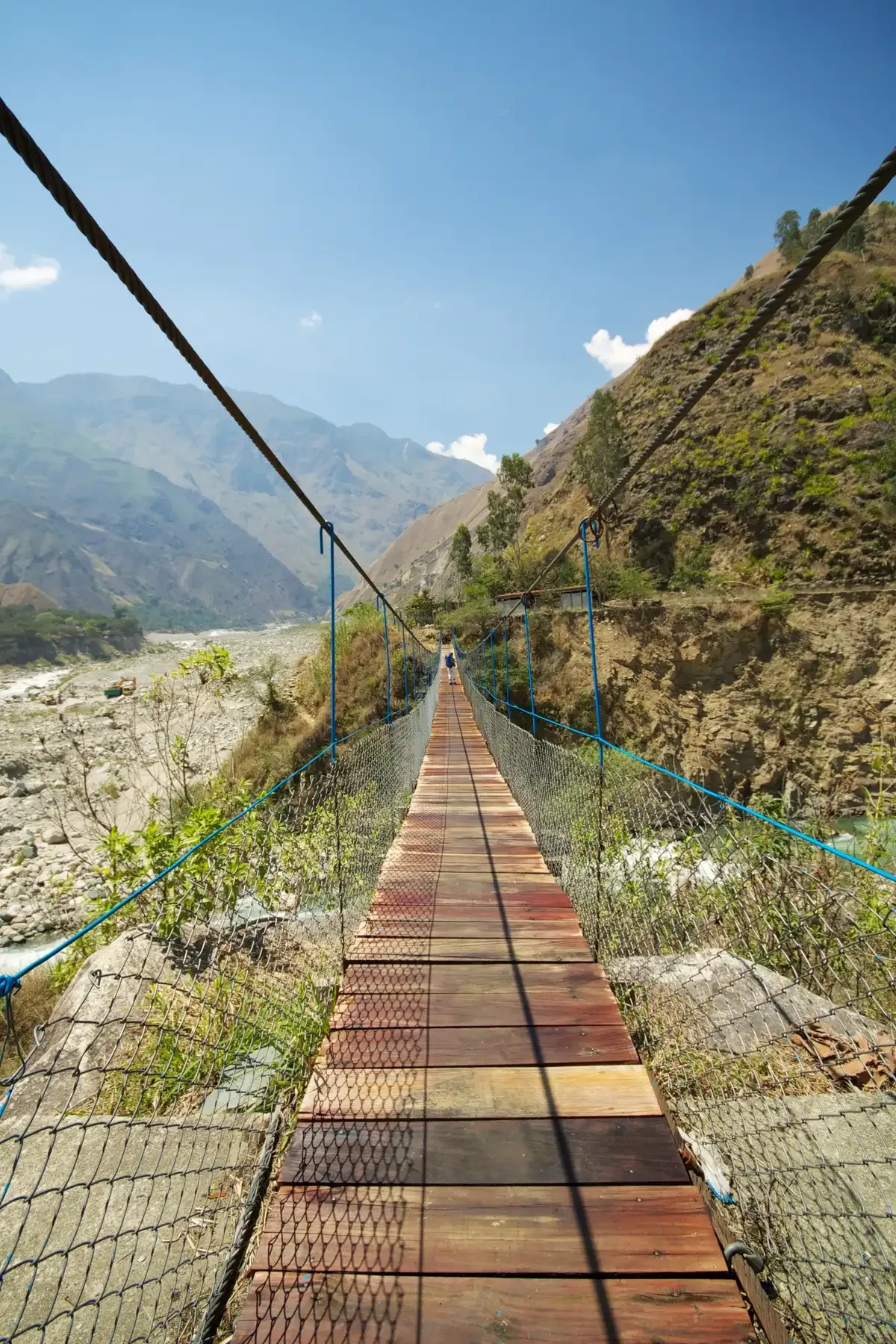
A footbridge over the river on the trail from Santa Teresa. Photo: McKay Savage from London, UK, CC BY 2.0, via Wikimedia Commons
Packing Questions
What temperature should my sleeping bag be rated for on the Salkantay Trek?
A bag rated to -10 C is the safe choice for the high camps, where dry-season nights reach about 0 C and winter nights minus 5 C. Operators recommend a mummy shape with a hood, and rental bags are rated down to -18 C. See the sleep section of the packing list for details.
How much weight can the mules or porters carry for me?
Plan for 5 to 7 kg. Salkantay Trekking limits the classic duffel to 5 kg including sleeping bag and mat, Alpaca Expeditions says porters carry up to 7 kg, and one trekker account reports 4 to 8 kg moving between camps. The full what the tours provide section lists the rental prices for gear.
Do I need to bring my own trekking poles?
Not always. Some tours include them, such as the 5-day listing with gear and the 2-day Humantay option, and operators rent pairs for US$25. Adjustable poles of about 350 g are recommended because the descent from Salkantay Pass is hard on knees.
How much cash should I pack for the Salkantay Trek?
Carry 200 to 300 soles of extra cash, the amount Salkantay Trekking advises, plus the trek entrance fee of roughly S/10 to S/20 payable at the start. Bring soles, because snack stands, toilets and some lodging are cash only and the only ATM on the route is believed to be in Aguas Calientes. More on money sits in the documents and money list.
Can I carry a large backpack into Machu Picchu?
No. Alpaca Expeditions says bags larger than 25 litres are not allowed inside the site, and food is prohibited while water bottles are fine. Salkantay Trekking suggests a 25 to 30 litre daypack with a rain cover for the trek, so carry a smaller bag of 25 litres or less for the ruins. See the day pack section.