 Salkantay Trekking Tours
Salkantay Trek vs Inca Trail
The Salkantay trek vs Inca Trail question comes down to paperwork and scenery. The Inca Trail needs a permit from a pool of 500 people a day, of which only about 200 are trekkers. The Salkantay needs no permit at all. This page compares the two routes side by side: length, highest pass, days, Inca sites, camps, crowds, booking lead times, the February closure and the very different ways they arrive at Machu Picchu. The bookable treks are compared on Salkantay trek tour.
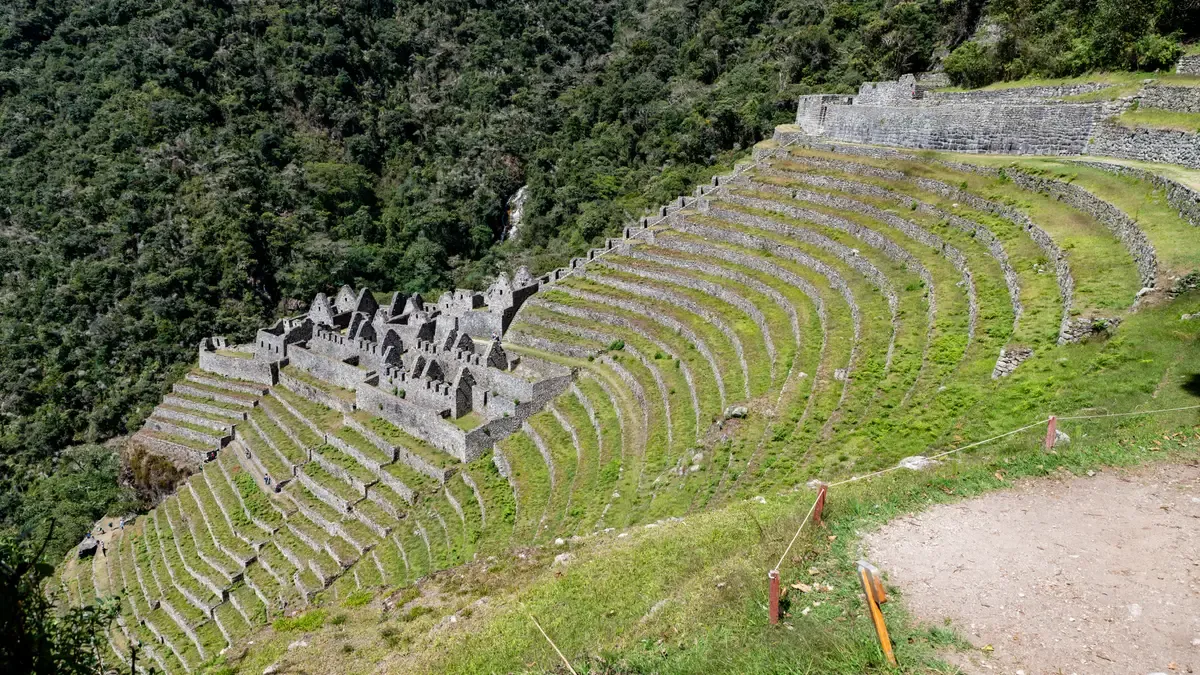
Wiñay Wayna, the terraced Inca site on the Classic Inca Trail. Photo: Christoph Strässler, CC BY-SA 2.0, via Wikimedia Commons
Quick answer Salkantay or Inca Trail
The core difference is access: the Salkantay Trek needs no permit, while the Classic Inca Trail caps entry at 500 people per day, of which only about 200 are trekkers. The Salkantay is also the longer and higher walk, at roughly 70 to 75 km with its pass near 4,630 m, against the Inca Trail's 42 km and 4,215 m Dead Woman's Pass. The Inca Trail closes every February. Both end at Machu Picchu, but only the Inca Trail arrives through the Sun Gate.
Key takeaways
- If you want a roof over your head instead of a tent, see the Salkantay Glass Cabins 5-Day Trek at $695, which includes the Machu Picchu ticket and the train back.
- Several trekkers who did both call the Salkantay the tougher walk, and day 2 over the pass is its hardest day. Read how hard is the Salkantay trek before deciding.
- Trace the Salkantay route stage by stage on the Salkantay trek map.
- One operator advises booking Inca Trail permits 5 to 6 months ahead for peak season, and the trail shuts in February. The Salkantay needs no permit and runs year-round.
Salkantay Trek vs Inca Trail Side by Side
The table puts the two routes next to each other on the ten points that decide the choice.
The Ten Deciding Factors
The figures below come from published route descriptions and operator pages. Where sources disagree, the table gives the range rather than one number. The Salkantay figures describe the standard Mollepata to Aguas Calientes route over Salkantay Pass, and the Inca Trail figures describe the Classic 4 to 5 day route from the trailheads 82 or 88 km from Cusco.
Distances vary because operators start at different points and count side trips differently.
| Feature | Salkantay Trek | Classic Inca Trail |
|---|---|---|
| Permit | None needed | Yes, first come first served |
| Daily cap | No cap | 500 people a day, only about 200 trekkers, the rest guides and porters |
| Length | About 70 to 75 km from Soraypampa, about 92 km from Mollepata | 42 km (26 mi) |
| Highest point | Salkantay Pass, quoted 4,580 to 4,660 m, most sources 4,630 m | Warmi Wanusqa (Dead Woman's Pass), 4,215 m |
| Days | Traditionally 5, often shortened to 4 or a hard 3 | 4 to 5 days |
| Closed months | Never, runs year-round | Every February for cleaning |
| Guide required | Independent trekkers report none is required | Yes, a registered licensed guide is mandatory |
| Sleeping | Domes, glass cabins, huts or tents, plus a hotel night in Aguas Calientes on most tours | Camps arranged by the licensed operator |
| Arrival at Machu Picchu | Via Hidroeléctrica and a flat walk or a 30 minute train ride into Aguas Calientes, then bus or stairs up | On foot through the Sun Gate (Inti Punku) at about 2,720 m |
| Inca sites on the way | At most one, usually Llactapata at 2,700 m | Llactapata, Runkurakay, Sayacmarca, Phuyupatamarca, Wiñay Wayna and the Sun Gate |
What the Table Means
Read the rows together and two characters emerge. The Inca Trail is a guided archaeological corridor: 42 km, a chain of named Inca sites, a mandatory guide, a hard permit ceiling and a sunrise entrance through the Sun Gate that no other route can copy. The Salkantay is a mountain and landscape route: no permit, no closure, a higher pass at around 4,630 m against 4,215 m, longer walking days of 20 km or more against the Inca Trail's single 16 km day 2, and a finish that runs through Hidroeléctrica and Aguas Calientes rather than the Sun Gate.
One hiker who walked both judged Salkantay harder, citing the long climbs to the pass and again to Llactapata. If the Sun Gate and the ruins matter most, pick the Inca Trail. If a quieter trail, glacier views and a dome with a clear ceiling matter more, pick the Salkantay, and check the comparison table of bookable departures on the homepage before you pay.
Permits, Booking and the February Closure
Paperwork is the sharpest difference between the treks, and it drives how far ahead you must book.
How the Inca Trail Permit System Works
All Inca Trail permits for the year are released each October and sold first come first served. The cap is 500 people per day on the classic routes, and that figure counts everyone: only about 200 of the slots go to trekkers, the rest to guides and porters. So the real trekker supply is a fraction of the headline number.
Every trekker must go with a registered guide, independent trekking is not permitted, and operator pages say a 2022 porter law set the maximum load at 20 kg for men and 15 kg for women and youth, down from 25 kg. The trail closes entirely every February for cleaning, no permits issued. One operator recommends booking permits at least 5 to 6 months ahead for peak season, and 2 to 4 months ahead for the shorter 2-day trail.
Ask your operator for the current permit price, since operators add their own service fees.
Salkantay: No Permit, One Trail Fee
The Salkantay needs no permit. There is no quota and no release date, and independent trekkers report that no guide is required, so you can start any day of the year and walk it independently if you choose. Two costs still apply.
A trek fee of roughly S/10 to S/20 per person is collected at the start, and everyone needs a Machu Picchu entrance ticket. Foreign adult tickets are S/152 on the standard circuits and S/200 for tickets that include a mountain climb such as Huayna Picchu, which itself has only 350 tickets a day. Entry requires an authorised guide inside the site, tickets are sold through tuboleto.cultura.pe and are non-transferable and non-refundable.
Note that Salkantay tours differ on whether the ticket is in the price: the Salkantay Glass Cabins 5-Day Trek at $695 includes entry fees for both Salkantay and Machu Picchu, while the Sky Lodge Domes 4-Day Trek at $680 lists the Machu Picchu entrance separately at USD 48, so read the inclusions before booking.
How Far Ahead to Book Each Trek
The lead times follow from the paperwork. For the Inca Trail, work backwards from 5 to 6 months before your date in peak season, because once the roughly 200 daily trekker slots are gone there is no alternative on that trail, and February is closed regardless. For the Salkantay there is no permit deadline, so bookings follow the operator's own logistics instead.
One 5-day listing asks you to book at least 3 months ahead and contact the supplier immediately, and one operator's Machu Picchu ticket policy guarantees the Circuit 2 entry only for bookings made 5 months ahead, with later bookings assigned Circuit 3 or Circuit 1 depending on availability. Machu Picchu itself caps entry at 5,600 tickets a day in high season and 4,500 the rest of the year, so even a permit-free trek needs a dated ticket. In short, the Inca Trail punishes late planners and the Salkantay mostly does not, which is the single most practical answer to the Salkantay trek vs Inca Trail question.
Inca Trail vs Salkantay Trek to Machu Picchu
The two routes compared on camera, from permits to scenery. Third-party video by TourRadar. This site did not shoot it and has no relationship with the creator.
How the Walking Compares
Both treks end at Machu Picchu, but the days on foot are shaped very differently. Here is how the pass days, distances and terrain stack up, from published route data.
The High Points
The Inca Trail tops out at Warmi Wanusqa, Dead Woman's Pass, at 4,215 m (13,829 ft). The Salkantay Pass sits higher. The figure most often quoted is 4,630 m, with sources publishing anything from 4,580 to 4,660 m. That is well above Dead Woman's Pass, and it comes after a 7 km climb from Soraypampa at about 3,900 m, on switchbacks one operator calls the path of the 7 snakes.
On the Inca Trail, Runkurakay sits at 3,750 m and Phuyupatamarca at 3,650 m. One trekker's account puts two full days of the Salkantay above 3,500 m. See how hard is the Salkantay trek for training and acclimatisation advice.
Daily Distances and Length
The Classic Inca Trail is 42 km (26 mi) over 4 to 5 days, and its one long day is day 2 at 16 km. Salkantay is longer. Sources quote the route at 56 to 74 km depending on the start point, and about 92 km from Mollepata. The 5-day classic itinerary at Salkantay Trekking covers 73.3 km with published daily stages of 10, 23.5, 17, 25 and 3 km.
That means the Salkantay's longest days run 20 km or more against the Inca Trail's single 16 km day. One trekker who did both judged Salkantay the harder walk for exactly that reason, citing the long climb to the pass and again to Llactapata. The full stage breakdown lives on the Salkantay trek map page.
Terrain and Cold Nights
The Salkantay starts in high Andean country with freezing nights. Weather around Salkantay spans about 15 C by day and as low as minus 10 C at night in the high areas, and one account puts Soraypampa nights near minus 5 C in winter. Pack for it with the Salkantay trek packing list.
After the pass the routes split in character. Salkantay drops more than 2,000 m from the pass into humid cloud forest, where conditions turn much warmer and the trail becomes rugged dirt with a few rocky sections. The Inca Trail gains about 2,500 m in total and ends at Machu Picchu at 2,430 m. The Salkantay ends with a flat walk along the railway to Aguas Calientes.
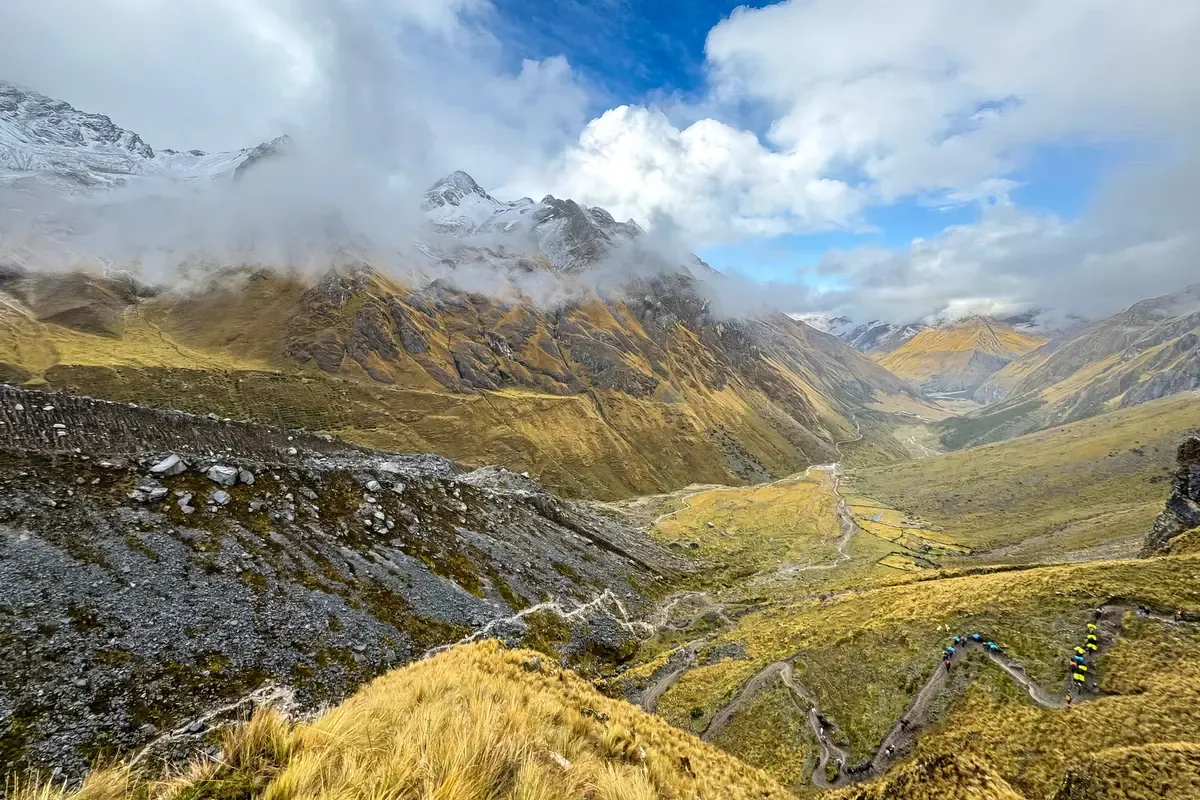
The switchbacks below the Salkantay Pass with the glacier peaks in cloud. Photo: Steve FUNG, CC BY-SA 4.0, via Wikimedia Commons
What You See on Each
This is the core of the choice. The Inca Trail is a chain of Inca sites ending at the Sun Gate. The Salkantay is a mountain and landscape route that reaches Machu Picchu from below.
Salkantay: Glacier, Lake, Cloud Forest and Coffee
The Salkantay peak stands at 6,271 m (20,574 ft) and dominates the first two days. Its name comes from the Quechua word sallqa, meaning wild, hence the translation Savage Mountain, and the dry season from May to September brings the clearest glacier views.
The Humantay Lake detour from Soraypampa adds about 4 km and 300 m of climbing to a glacial lake at 4,200 m, and it is included on most bookable departures. Below the pass the trail drops into cloud forest, passing through La Playa and Lucmabamba. On the 5-day route, day 4 climbs about 2 hours to Llactapata at 2,700 m for a first distant view of Machu Picchu before descending to Hidroelectrica and the track to Aguas Calientes. Note that the Llactapata trail is not guaranteed in the rainy season because heavy rain makes it dangerous.
The comparison of every bookable Salkantay departure sits in the comparison table on the Salkantay trek tours homepage.
Inca Trail: The Sites and the Sun Gate
The classic route strings together Inca settlements the whole way. The main sites named in route guides are Llactapata, Runkurakay at 3,750 m, Sayacmarca, Phuyupatamarca at 3,650 m, Wiñay Wayna at about 2,666 m and finally Inti Punku, the Sun Gate, at about 2,720 m.
The payoff is the arrival. Reaching the Sun Gate for sunrise over Machu Picchu is only possible on the Inca Trail, and it means leaving the last camp at about 3 to 3:30 am on day 4. On the Salkantay you visit at most one Inca site, Llactapata, because the route is built around natural scenery rather than archaeology. If ruins are the reason you are going, the Inca Trail wins.
Which One to Book
Permits, timing and comfort decide it for most people. Two short profiles cover the usual cases.
Book the Salkantay If You Are Booking Late or Want Comfort
The Salkantay needs no permit, so departures run year-round including February, when the Inca Trail closes for cleaning. There is no 500-a-day quota and no permit deadline, although some listings ask for earlier booking. If your trip is close, check each listing's lead time.
It also wins on sleeping arrangements. The Salkantay Sky Lodge Domes Trek at $680 puts you two nights in glass-topped domes with private bathrooms and hot showers. The Salkantay Glass Cabins Trek at $695 adds glass cabins, glass domes, a hobbit house and a 4-star hotel night, with entry fees and the train back included. At the budget end, the Salkantay Panoramic Domes Trek at $300 is a 5-day dome-camping route.
Book the Inca Trail If You Want the Ruins and the Sunrise
Choose the Inca Trail if walking past six named Inca sites and entering Machu Picchu through the Sun Gate matters more to you than mountain views. It is also the shorter commitment, at 42 km over 4 to 5 days with a longest day of 16 km, and Explorandes rates it moderate to challenging against the Salkantay's challenging to strenuous.
The costs are the trade-off. A reputable 4-day group trek is budgeted at US$800 to 850 in one guidebook source, against Salkantay departures here from $300 to $1,265, which differ in what they include. All trekkers must go with a registered guide, only about 200 of the 500 daily slots go to trekkers, permits are released each October and one operator recommends booking 5 to 6 months ahead for peak season. If neither profile fits and you want a shorter no-permit alternative, the Lares trek runs 33 km in 3 days over the 4,450 m Ipsaycocha Pass and ends in Ollantaytambo.
Salkantay or Inca Trail: Your Questions
Is the Salkantay Trek harder than the Inca Trail?
Several first-hand accounts say yes, mainly because of distance. Salkantay's long days run 20 km or more against the Inca Trail's single 16 km day 2, and its pass at about 4,630 m sits above Dead Woman's Pass at 4,215 m. The full picture is on the Salkantay trek difficulty page.
What is the difference between the Salkantay and the Inca Trail?
The Inca Trail is a 42 km permitted route past sites like Wiñay Wayna, ending at the Sun Gate. The Salkantay is a longer, no-permit mountain route of roughly 56 to 74 km that reaches Machu Picchu from Hidroelectrica and Aguas Calientes. The side-by-side numbers are in the comparison table.
Do I need a permit for the Salkantay Trek?
No. The Salkantay has no permit system and no daily quota, unlike the Inca Trail's 500-person-a-day cap of which only about 200 slots go to trekkers. You still pay a small trail fee of roughly 10 to 20 soles at the start, and Machu Picchu entry is separate. Costs are broken down on the Salkantay trek cost page.
When is the Inca Trail closed?
The Inca Trail closes every February for cleaning. The Salkantay has no closure and runs all year, though the rainy season from November to March brings mud and can make the Llactapata trail dangerous. Month-by-month advice is on the best time to do the Salkantay trek page.
Where does each trek arrive at Machu Picchu?
The Inca Trail arrives through Inti Punku, the Sun Gate at about 2,720 m, in time for sunrise. The Salkantay route arrives from below, either walking about 10 km along the railway from Hidroelectrica to Aguas Calientes and then up to the gate, or taking the bus. The route day by day is on the Salkantay trek map page.
How far ahead should I book each trek?
For the Inca Trail, one operator recommends booking permits 5 to 6 months ahead for peak season, since all permits for the year are released in October. For the Salkantay there is no permit, so there is no permit deadline, though some listings ask for months of notice and Machu Picchu entry tickets are capped daily. Browse current departures of Salkantay trekking tours to compare.